

How Thermographic Inspections Work
Thermography measures surface temperatures by using infrared video and still cameras. These tools see light that is in the heat spectrum. Images on the video or film record the temperature variations of the building's skin, ranging from white for warm regions to black for cooler areas. The resulting images help the auditor determine whether insulation is needed. They also serve as a quality control tool, to ensure that insulation has been installed correctly.
A thermographic inspection is either an interior or exterior survey. The energy assessor decides which method would give the best results under certain weather conditions. Interior scans are more common, because warm air escaping from a building does not always move through the walls in a straight line. Heat loss detected in one area of the outside wall might originate at some other location on the inside of the wall. Also, it is harder to detect temperature differences on the outside surface of the building during windy weather. Because of this difficulty, interior surveys are generally more accurate because they benefit from reduced air movement.
Thermographic scans are also commonly used with a blower door test running. The blower door helps exaggerate air leaking through defects in the building shell. Such air leaks appear as black streaks in the infrared camera's viewfinder.
Thermography uses specially designed infrared video or still cameras to make images (called thermograms) that show surface heat variations. This technology has a number of applications. Thermograms of electrical systems can detect abnormally hot electrical connections or components. Thermograms of mechanical systems can detect the heat created by excessive friction. Energy assessors use thermography as a tool to help detect heat losses and air leakage in building envelopes.
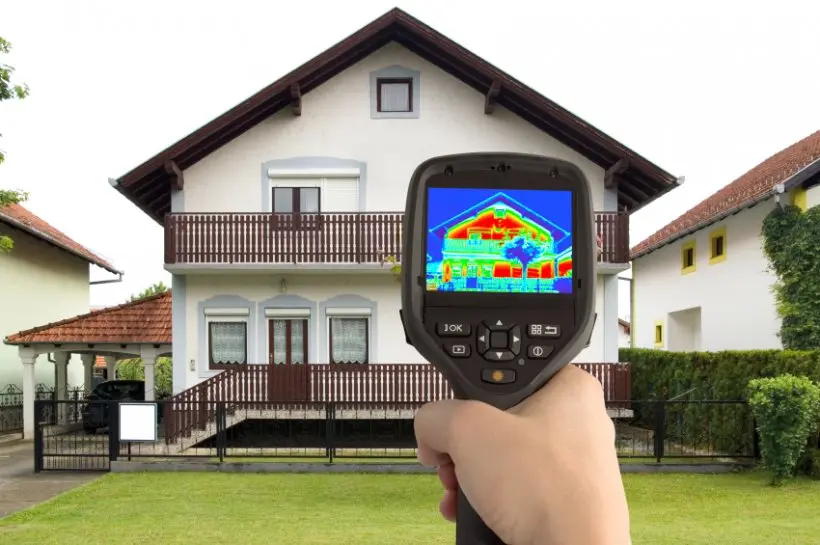
Infrared scanning allows energy assessors to check the effectiveness of insulation in a building's construction. The resulting thermograms help assessors determine whether a building needs insulation and where in the building it should go. Because wet insulation conducts heat faster than dry insulation, thermographic scans of roofs can often detect roof leaks.
In addition to using thermography during an energy assessment, you should have a scan done before purchasing a house; even new houses can have defects in their thermal envelopes. You may wish to include a clause in the contract requiring a thermographic scan of the house. A thermographic scan performed by a certified technician is usually accurate enough to use as documentation in court proceedings.
Types of Thermographic Inspection Devices
The energy assessor may use one of several types of infrared sensing devices in an on-site inspection.
A spot radiometer (also called a point radiometer) is the simplest. It measures radiation one spot at a time, with a simple meter reading showing the temperature of a given spot. The auditor pans the area with the device and notes the differences in temperature.
A thermal line scanner shows radiant temperature viewed along a line. The thermogram shows the line scan superimposed over a picture of the panned area. This process shows temperature variations along the line.
The most accurate thermographic inspection device is a thermal imaging camera, which produces a 2-dimensional thermal picture of an area showing heat leakage. Spot radiometers and thermal line scanners do not provide the necessary detail for a complete home energy assessment. Infrared film used in a conventional camera is not sensitive enough to detect heat loss.
Preparing for a Thermographic Inspection
To prepare for an interior thermal scan, the homeowner should take steps to ensure an accurate result. This may include moving furniture away from exterior walls and removing drapes. The most accurate thermographic images usually occur when there is a large temperature difference (at least 20°F [14°C]) between inside and outside air temperatures. In northern states, thermographic scans are generally done in the winter. In southern states, however, scans are usually conducted during warm weather with the air conditioner on.
Some times of the year, because of a phenomenon known as “thermal loading,” it might be necessary for the homeowner–depending on local conditions--to create and maintain a specific inside/outside temperature difference for a period of up to four hours before the test will be performed. Running the air conditioner in cooling climates or the central heat in heating climates can do this. Ask the auditor prior to the test if this will be necessary.
Blower Doors: What Are They and How Do They Work?
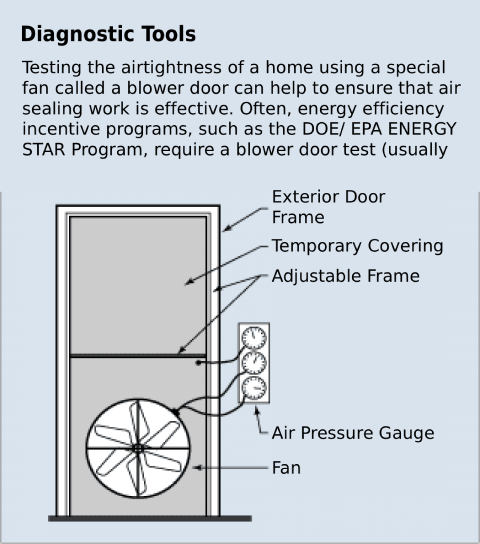
A blower door is a powerful fan that a trained energy professional temporarily mounts into the frame of an exterior doorway in your home. After calibrating the device, the fan pulls air out of the house, lowering the air pressure inside. The higher outside air pressure then flows in through all unsealed gaps, cracks and openings such as gaps, cracks, or wiring penetrations. If conditions do not allow for lowering the pressure in the home, the fan may also be operated in reverse, with air pressure increased inside the home.
While the blower test is being conducted, the analyst may use an infrared camera to look at the walls, ceilings, and floors, to find specific locations where insulation is missing and air is leaking. The analyst may also use a nontoxic smoke pencil to detect air leaks in your home. These tests determine the air infiltration rate of your home, which is recorded on a laptop or tablet.
The blower door test is conducted as part of the energy assessment of your home. Your contractor may also operate the blower door while performing air sealing (a method known as blower door assisted air sealing), and after to measure and verify the level of air leakage reduction achieved.
Blower doors consist of a frame and flexible panel that fit in a doorway, a variable-speed fan, a digital pressure gauge to measure the pressure differences inside and outside the home, which are connected to a device for measuring airflow, known as a manometer.
There are two types of blower doors: calibrated and uncalibrated. It is important that auditors use a calibrated door. This type of blower door has several gauges that measure the amount of air flowing out of the house through the fan.
Uncalibrated blower doors can only locate leaks in homes. They provide no method for determining the overall tightness of the home.
The calibrated blower door's data allow your contractor to quantify the amount of air leakage prior to installation of air-sealing improvements, and the reduction in leakage achieved after air-sealing is completed.
Editor's Note: The content on this page has been adapted and consolidated from official public domain resources originally published by the U.S. Department of Energy (DOE). The original pages have since been decommissioned but remain accessible via the Internet Archive:
- Thermographic Inspections: Originally published on energy.gov/energysaver/thermographic-inspections. View the archived version from March 17, 2026 on the Wayback Machine.
- Blower Door Tests: Originally published on energy.gov/energysaver/blower-door-tests. View the archived version from March 23, 2026 on the Wayback Machine.